Analiese Gregory: Lumachelle |
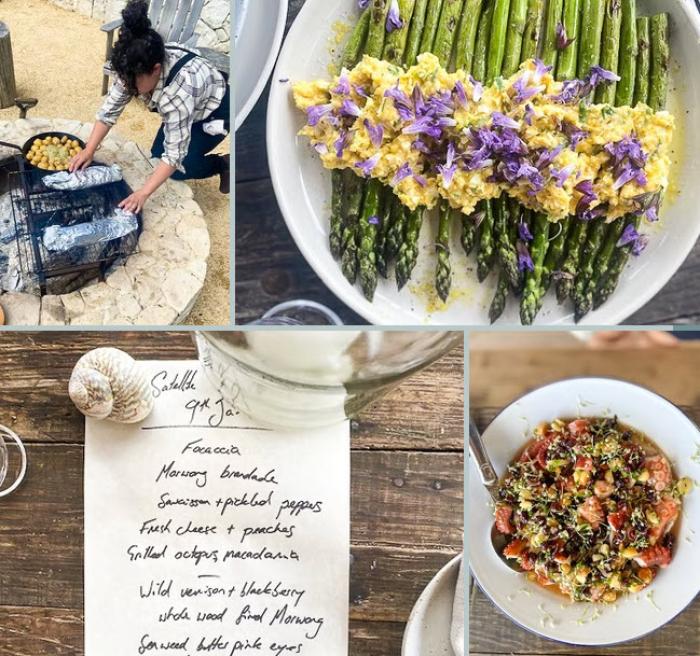
Hailed as one of the most exciting chefs of her generation, Analiese Gregory has swapped the dazzling Michelin star restaurants of Paris's Le Meurice and Sydney's Quay for rugged Tasmania.
She has left her high pressure restaurant career for a century old cottage at the bottom of the world in Tasmania. Here, she strives to forge a new life for herself, learning to hunt, fish, forage and live seasonally, closer to nature.
Analiese Gregory offers unique private catering experiences for business or personal occasions where she creates a menu for you based upon what is truly seasonal in Tasmania at the time and sourced from an extensive array of local farmers, fishermen and artisans.
Lumachelle
A 10-seater home-based restaurant - Opening 2026
She made her name as Australia's "wild" chef. Now Analiese Gregory is bringing it all home with an intimate new farm-restaurant venture.
On a quiet bend of the Huon River, Analiese Gregory is preparing for her next adventure. Lumachelle, a 10-seater home-based restaurant - or "anti-restaurant" as she boldly describes it - is expected to open for lunch for a few days a week through summer. Having anointed her as one of the most exciting chefs of her generation, the food world is abuzz with news of the venture. The mood Chez Gregory, though, is a little more sober.
The self-confessed "chef nerd" is weighing the demands of working both a kitchen and a room - a room of her own - as both cook and host. "It's going to be a challenge because I'm actually a massive introvert, so it's going to be a big life change," she confesses in her prim tones, as we survey the encircling hills from the front deck of her weatherboard Federation cottage in the Huon Valley, south of Hobart. An introvert who happens to be an extrovert? I ask. "Yes, one of those," she shoots back with a quick smile.
Wearing jeans and a bulky forest-green turtleneck, Gregory, the 41-year-old New Zealand-born poster princess for wild Tasmanian cuisine, gestures towards the gently undulating Sleeping Beauty Mountain to the north-west - beyond it, the island's great glaciated wilderness - before turning towards the closest range to the south. "The snows on that hill seem to come closer each year," she says, grimacing at the prospect of a micro-climate giving the finger to global climate change. This grey, blustery October day is certainly defying spring. "I was going to take you foraging," she apologises as we step inside from the crisp air, "but the weather's a bit snotty. Super windy. And rainy. But I went a few days ago when it cleared to forage seaweed down at Charlotte Cove [south of Cygnet] and got some abalone as well."
Gregory and her partner, Kobi Ruzicka, the patron-chef-owner of Lucinda wine bar and adjacent restaurant Dier Makr in Hobart, are knocking up a pizza strewn with this abalone, finely sliced, on a butter-cream base, topped with garlic and fresh garden herbs and a dusting of parmesan. Abalone pizza is not, in culinary terms, a thing. But the couple have recently acquired an outdoor pizza oven. "And we thought, would these two things fit together? And it turned out to be really good. And unexpected!" Abalone pizzetta is now heading for her first menu.
A weak grey light washes over a timber-slab kitchen benchtop and half a dozen freshly made chevres, all white and glistening in their plastic-mesh moulds. "It's spring, milk is just coming back in and these are from goats near Geeveston, about 20 minutes south," she says proudly. Her pride is well-placed. Gregory came to this part of the world as a highly regarded young chef, but the longer she stays, the more of an artisan she becomes. "I think of them as 'grandma skills'," she says of her keen interest in making and preserving all manner of things, from cheese-making to jam, seed-saving to syrup.
We sit at the hub of her new venture, a 10-seat table made from salvaged Oregon pine - deeply grained, dinged and patched-up, from an American ship that met its end in these waters a century ago. In the table's centre stands a grey ceramic vase sprouting some desultory dried flowers: it's not, at least not in this pre-launch phase, a swish place. There's a herb garden on the home's north-western side, and at the rear an orchard "where the chickens and goats roam, and we have pigs," she adds rather gleefully, "until we eat them".
One wall of the modest dining room is lined with shelves of preserved truffle honey, black garlic, quince jelly, apricots, wild fennel seeds, pine bud extract. Beside her "library of Tasmanian tastes" stands a glass fridge filled with crimson cuts of homemade charcuterie. "A pig from a mate's farm," she says, as if making an introduction. Ruzicka, who will contribute his vast wine collection and viticultural knowledge to the new venture, swings open the door of a heavy-duty Esse wood-burning stove and plunges parboiled greens into the squeaky coals. After a minute, he brings them to the table to serve with the abalone pizzetta.
I'm sceptical of the obligatory "wows" offered by cooking-show presenters, yet it is, well, a blast. Intensely flavoursome, yet light and unfussy. "It feels very.. Tasmanian," the wild chef adds with a rising inflection. We raise a glass of local cider, homage to the apple trees blossoming throughout the Huon Valley at this time of year.
Gregory's home sits among hills facing the south-west wilderness but there's another kind of wild place to the east, where the settlements along the southern Tasmanian coast give way to cold, chalk-white beaches. Beyond the island's eastern seaboard, there's nothing but the great Southern Ocean spinning clockwise around the South Pole. Save for the industrial-scale salmon farms fouling the Huon waterway, a more pristine environment can scarcely be imagined. "I can get in the car and be on the coast in half an hour," she says.
Gregory has carefully nurtured an outdoor-girl shtick since migrating to Tasmania in 2017 with experience in high-end kitchens in Paris, London, Spain and Sydney. In her bestseller pandemic-era book, How Wild Things Are: Cooking, Fishing and Hunting at the Bottom of the World, the "chef's table" is a rustic bench, the kitchen is a pot on a charcoal fire, and the pantry is that icy Southern Ocean.
Does she dive in winter? "Well, I have this super-thick wetsuit with a hood and gloves and boots, so in winter, yes, I go in," she says in a tone of apologetic candour, as if the world might be expecting more of her. It's not so much the cold that holds her back, she adds, as poor winter light and shearing gales. Ruzicka stays on the shore and does the spotting. "He makes sure I don't die," she says matter-of-factly. She pauses, then opens up with an admission. The superwoman-in-a-wetsuit persona, the Bond Girl of global gastronomy, didn't come naturally. She's had to work on it. "I've always been scared of the water. I was a really shit swimmer growing up. I'm still not a very good swimmer." But she's nothing if not pragmatic and if there's a challenge with a purpose - "to get seaweed, find abalone, pick a rare plant" - she'll rise to it.
It's this pragmatic approach to self-mastery that prompted her to adopt a swarm of bees now contentedly installed in a hive behind the cottage. "I have a chequered history with bees," she admits. "One year a hive swarmed [a natural process in which about half a bee colony leaves to create a new home] and I climbed a rickety ladder with a saw to cut down the branch they'd landed on. Just as I sawed through the branch I dropped it on the ground, and they swarmed over my face and stung me. I ended up in hospital. And now I'm allergic to bees."
What, then, are you doing with a swarm of bees now? I ask. "Very good question," she replies as Ruzicka inclines his head thoughtfully. "Do you ever do something that might not be good for you? You can't give it up? I go through phases of being scared of the bees because they cause me so much pain when they sting me. But I guess I like having them around. And you know bees are kind of slowly dying off. They're good for the world. For pollination. And in Tasmania, we have fewer bee diseases than the mainland. Here we're kind of like the last bastions of safety for the bees."
So she's a bee mother? "I guess," she replies, "but I don't know how else to be - no pun. Besides, if you open the hive and you get fresh honeycomb it's like, out of this world." Her hands unfold as she conjures the taste of hive-to-tongue fresh honey. "Nothing compares to it."
Born in Auckland to a Chinese-Dutch mother and a Welsh father, Gregory was raised, as she puts it a little wistfully in Wild Things, in the land of the long white beach, "of weekends spent snapper fishing, collecting pipis in buckets and boiling them with samphire on an outdoor stove". As a kid she was always busy messing about in kitchens, baking cakes. It was, though, a restless life. The family spent two years caravanning around Australia. At 17, a year after she'd started cooking for a living, she took the great antipodean rite of passage to London. "It was the whole thing about being from this tiny island at the end of the world. I needed to escape from it. I had to go out into wider world."
She started with the Michelin-starred Capital Hotel and the Ledbury before time in Paris, at the fine-diner Le Meurice. Returning to Australia with a blended accent that stuck and held firm - part Kiwi, part Chelsea - she worked at the Bentley in Sydney's CBD before a five-year stint with Peter Gilmore at Quay. It was during her time at Quay that her curiosity spiked about the source of so much Tasmanian produce landing in the kitchen - pink fir apple potatoes, greenlip abalone, southern rock lobsters - and she headed to Hobart to check it out. She stayed with friends.
"It was one of the most civilised things I'd ever experienced," she recalls. "Champagne at 5pm and off to Garagistes [the acclaimed diner helmed by chef Luke Burgess] for dinner. I climbed the mountain, went to the farmers' markets, and fell in love with Tasmania." Part of the city's charm was the visible, palpable presence of nature - river, harbour, mountains - on all sides. It's a quality the Tasmanian capital shares, she believes, with "a number of smaller cities in the world where you can see nature just there, on the edges. Kyoto is another one."
In 2015, she left Quay for another wander. This time she headed for Michel Bras' eponymous restaurant in the southern French region of Aveyron and the highly regarded Mugaritz, near San Sebastian, followed by a two-month pop-up residency at Restaurant Numero 7 in the walled Moroccan city of Fez. Her time overseas honed existing skills and broke down one particular barrier. Until she met Bras, she'd been scornful of stereotypical Nordic hipsters "out there drinking filter coffee and foraging sea buckthorn". But she was quick to convert. "I'd put on headphones and wander the woods for hours," she recalls. Soon she was appointed a sort of forager-in-chief in the kitchen, scouting for local intel about the best place for wild sorrel and dispatching small teams to different parts of the southern French countryside.
In 2017 she was recruited to run Franklin, a post-industrial space in an old Hobart car showroom. The forager and the locavore in Gregory, the lessons learnt in pressure-cooker Michelin-star kitchens and relaxed provincial eateries, all seemed to coalesce. While she follows no single tradition, it's clear that rural France is her abiding source of inspiration. The name of her new place, Lumachelle, is a nod to a favourite organic-style chardonnay from the Jura in eastern France. In preparation for its launch, Gregory and Ruzicka recently toured rural France's auberges, small rural inns offering food and lodging. "French country restaurants are places I really enjoy," she enthuses. "I'm quite influenced by them. It's not just about food; it's also about the feeling and atmosphere and the style of cooking. It's very vegetable-based. It's not even like farm-to-table, more garden-to-table."
One of her favourite auberges is Le Soleil in Savigny-les-Beaune, near Dijon; another, D'une Ile, a pretty country house in Normandy, she follows on Instagram. "There might be serious skill involved at an auberge, but things still feel rustic and relaxed. But I don't want things to be too rustic. I'm still trying to find the right balance."
There was a silver lining in the pandemic for Gregory. She'd been working monster shifts at Franklin, with six sous-chefs and a post-industrial stage for a kitchen. But when normalcy returned, Franklin didn't. Hobart's destination restaurant, the culinary accompaniment to MONA, closed permanently in May 2020. This forced on Gregory a pause-and-reset she didn't know she needed. She spent lockdown in her Huon Valley cottage, meeting regularly with buddies Roger McShane and Sue Dyson, Hobart-based wine importers who've helped shape her journey in gastronomy as strongly, she believes, as chefs Peter Gilmore and Michel Bras.
"We formed a little club of four," she gestures companionably to Ruzicka, "called Poor Man's Lovage, after the herb. We'd cook for the sheer pleasure of it." McShane and Dyson would trawl through the culinary archives and turn up with, as she recalls, "a 16th-century Portuguese recipe for almond cake. And I'd think, 'Interesting - what could I do with that?'"
She also got to thinking about different ways of slicing and dicing the future. "Up to that time, I think I'd always assumed I'd take another head-chef job and commute to Hobart, probably leaving for home around 1am. But I started thinking, 'Maybe there's a way to work closer to home. Maybe I don't actually have to do that long haul.' Because everything seemed to work better when I was here at home. When I wasn't here the goats seemed to be escaping all the time and disappearing into the bush, and my chickens were getting eaten by dogs or going next door and living with other people, and the bees were swarming and I wasn't here to catch them. You can't run a proper country house while working 12 hours a day in the city. Also," she pauses for a deep breath, "I was really tired."
It was during this period that she found time to finish her Wild Things book, which spooled into an SBS TV series watched avidly around the world, followed by a new series earlier this year. Her celebrity status, like a well-made investment, has continued to grow, and among the dividends is the freedom to fulfil her dream of a French-style Tasmanian farm restaurant: a destination restaurant with a point of difference because the destination, for many, will be Analiese Gregory herself. When I ask if hanging out with Analiese Gregory is part of Lumachelle's likely appeal, she shrugs and smiles.
For the past five years, outside writing and filming around her life story, she's been making ends meet - "just", she adds - by hosting events on a private islet close by in the D'Entrecasteaux Channel. At Satellite Island, she cooks in the open with "whatever is in season and I'm interested in. So while I take feedback and preferences from people, I create the menu and decide what everyone will be eating."
She's keen to bring that big-sky campfire feel to Lumachelle. "We might have a large shared main like a whole rib-eye or a whole Stripey Trumpeter [a coveted Southern Ocean fish] and smaller, finer things as sides. Because I realise I like this way of cooking. I'm trying to find a way between my background in fancy restaurants and my last five years, where I've been basically wandering wild in Tasmania, lighting fires and cooking on them. I'd like to bring these two sides together in a way that makes sense and doesn't feel, like, jarring."
The threat of fatigue is a regular refrain during our lunch. Her desire to do things her way, at her own place - and her own pace - as free as possible from long, adrenaline-fuelled working weeks, is a hard-won life lesson learnt at the high end of hospitality. The sagacity of slowing down was confirmed late last year when she received a diagnosis of both autism and ADHD. "I think it explains the way I am," she offers. Explains? I press. "I suppose it explains my fatigue, love of nature, difficulty in communicating and fitting in with the world."
It's the deep desire for harmony - between work, life and the natural world in which she's immersed - that lies behind her set against the traditional model of the restaurant. "It's an alternative to the way I've lived my life until now. I need time to garden and write another book and forage and all the things I enjoy; until now, those things have been working against my life as a chef."
The idea is to integrate them. "It's also about using local ingredients, my own ingredients, and avoiding waste - the waste at the restaurants I've worked in, it's massive. I finally concluded, I just can't work like that any more. I want my own place to eventually be completely off-grid, running off solar and a water tank. We'll compost - sometimes I have nine compost bins for different kinds of waste - and recycle."
She plans to deconstruct the conventional restaurant model with small tweaks such as a kind of gastronomic intermission during the meal - "people can go for a wander around the place or meet me down at the fire pit." Her reasoning is that long, sedentary meals aren't entirely natural. In fact, it seems strange to Gregory that the restaurant, which has its roots in ideals of restoration, revival and rejuvenation, can end up exhausting both overworked staff and over-fed diners.
She hopes to offer her guests a restorative break - a day out, perhaps overnight if she can manage to add a couple of rooms to the house. It's part of the appeal of the auberge. Driving into the country, bags packed, is "a lot more fun than walking along the city street", she says. "I like the idea of a journey."
She's content enough with the shape of her own journey, having found a home in the country that fulfils her yearning to make, to create, and a way of working that keeps the goats in order, the chickens laying and the bees - the dreaded bees - from matricidal swarming.
Analiese Gregory, the gastronomic gypsy, has stopped wandering. She's one of the most recognisable international expressions of all things exceptionally Tasmanian. And the irony is not lost on her - very little is - that the arc of her life has taken her from one small island at the end of the world to another.
Source: How a quiet corner of Tasmania could be the setting for Australia's first 'anti-restaurant'
By Luke Slattery | theage.com.au
December 11, 2025
Restaurant Bookings Opening Soon!
Subscribe to the mailing list to be notified when restaurant bookings are open and receive early access to info and reservations.
We are currently working hard to get the restaurant open soon!
Stay tuned in - we hope to have an opening date announced shortly.
❊ Address ❊
⊜ 99 Benders Road Huonville 7109 View Map
❊ More Information ❊
→
www.analiesegregory.com
➼ www.analiesegregory.com
Update Page


✻ Featured ✻
Candlelight Concerts in Tasmania
Australian Fashion Superstore

Suncorp Super Netball 2026: Round 6

La Ronde: Circus, Cabaret & Comedy @ Spiegeltent Hobart

The Eagles Story - Another Tequila Sunrise Tour 2026 - Hobart

The Eagles Story - Another Tequila Sunrise Tour 2026 - Launceston
✻ Advertiser ✻
✻ What's On ✻




✻ Experiences ✻
Comedy
Eat & Drink
Events Calendar
Exhibitions
Experiences
Family Friendly
Markets
Music
Sales
Sightseeing
Sport
Theatre

✻ Featured ✻
Candlelight Concerts in TasmaniaAustralian Fashion Superstore
Suncorp Super Netball 2026: Round 6
La Ronde: Circus, Cabaret & Comedy @ Spiegeltent Hobart
The Eagles Story - Another Tequila Sunrise Tour 2026 - Hobart
The Eagles Story - Another Tequila Sunrise Tour 2026 - Launceston
✻ Advertiser ✻
✻ What's On ✻
✻ Experiences ✻
Comedy
Eat & Drink
Events Calendar
Exhibitions
Experiences
Family Friendly
Markets
Music
Sales
Sightseeing
Sport
Theatre
✻ Featured ✻
The Eagles Story - Another Tequila Sunrise Tour 2026 - Launceston
The Eagles Story brings one of the greatest rock bands of all time vividly to ..
The Eagles Story - Another Tequila Sunrise Tour 2026 - Hobart
The Eagles Story brings one of the greatest rock bands of all time vividly to ..
La Ronde: Circus, Cabaret & Comedy @ Spiegeltent Hobart
Step into the round and surrender to La Ronde - a lavish cocktail of circus, ..
Suncorp Super Netball 2026: Round 6
Suncorp Super Netball celebrates its tenth season in 2026 with a fixture full ..
Australian Fashion Superstore
Australia's online fashion icons featuring Australia's premier fashion brands, ..
Candlelight Concerts in Tasmania
Sometimes the simple things in life are the most memorable.
These candlelit ..
The Eagles Story - Another Tequila Sunrise Tour 2026 - Hobart
La Ronde: Circus, Cabaret & Comedy @ Spiegeltent Hobart
Suncorp Super Netball 2026: Round 6
Australian Fashion Superstore
Candlelight Concerts in Tasmania
✻ Featured ✻
The Eagles Story - Another Tequila Sunrise Tour 2026 - Launceston
The Eagles Story brings one of the greatest rock bands of all time vividly to ..
The Eagles Story - Another Tequila Sunrise Tour 2026 - Hobart
The Eagles Story brings one of the greatest rock bands of all time vividly to ..
La Ronde: Circus, Cabaret & Comedy @ Spiegeltent Hobart
Step into the round and surrender to La Ronde - a lavish cocktail of circus, ..
Suncorp Super Netball 2026: Round 6
Suncorp Super Netball celebrates its tenth season in 2026 with a fixture full ..
Australian Fashion Superstore
Australia's online fashion icons featuring Australia's premier fashion brands, ..
Candlelight Concerts in Tasmania
Sometimes the simple things in life are the most memorable.
These candlelit ..
The Eagles Story - Another Tequila Sunrise Tour 2026 - Hobart
La Ronde: Circus, Cabaret & Comedy @ Spiegeltent Hobart
Suncorp Super Netball 2026: Round 6
Australian Fashion Superstore
Candlelight Concerts in Tasmania
✻ Trending ✻
→ Variety Tasmania
→ Cradle Mountain Wilderness Village
→ Bonneys Inn Bed and Breakfast
→ Rosies Inn Hotel & B&B
→ Collectors Corner
→ Island View Motel | Orford
→ Coal River Farm
→ Battery World | Hobart
→ Beaupre Cottage
→ Snug Beach Cabin & Caravan Park
→ Cradle Mountain Wilderness Village
→ Bonneys Inn Bed and Breakfast
→ Rosies Inn Hotel & B&B
→ Collectors Corner
→ Island View Motel | Orford
→ Coal River Farm
→ Battery World | Hobart
→ Beaupre Cottage
→ Snug Beach Cabin & Caravan Park